Radon Systems Fail Quietly. Here's How You'd Know.
A radon mitigation system has exactly one moving part — and it runs every hour of every day, through Bismarck winters and summer heat, for years. When the fan finally quits, nothing dramatic happens. No alarm, no leak, no smell. The pipe just goes silent, the manometer levels out, and the house drifts back toward whatever it read before the system went in — which, in a state where 63 percent of homes test high, is not a number you want back.
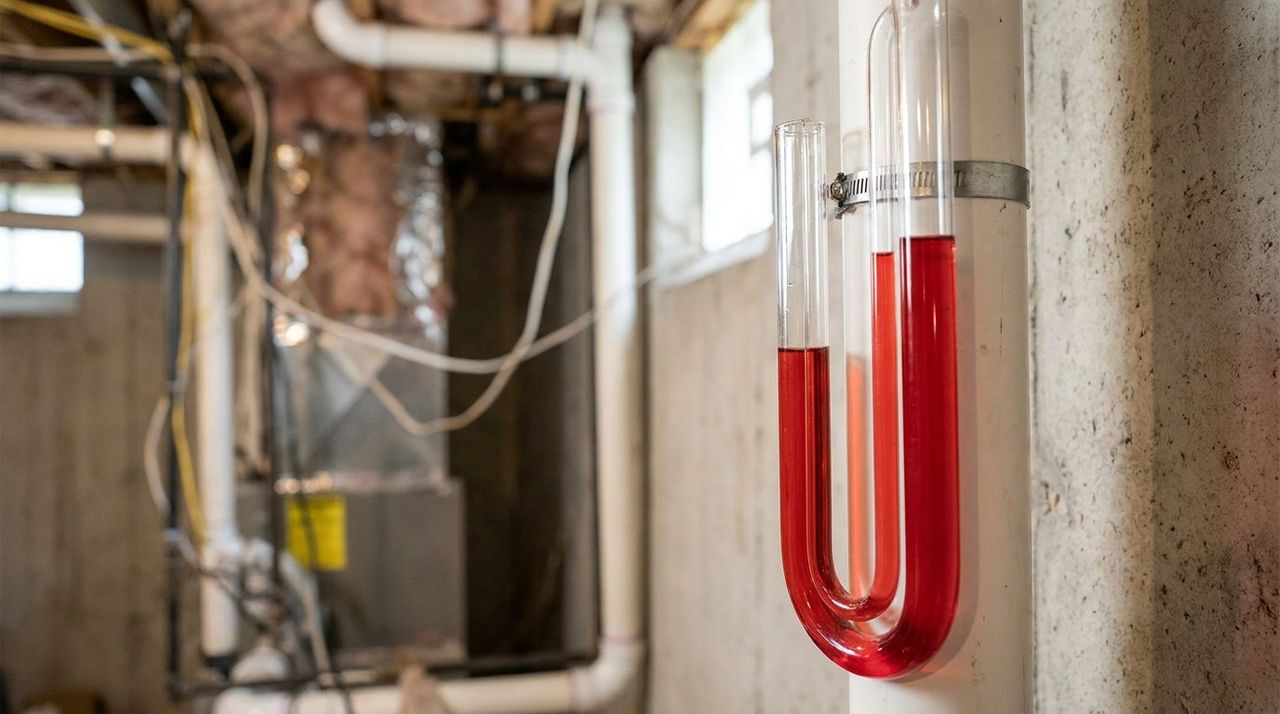
The five-second habit that catches it: glance at the U-tube manometer on the pipe. Uneven fluid = suction = working. Level fluid = dead fan. If yours is level, or the fan has started growling, that's the whole diagnosis — call us.
Fan Replacement — Any Brand, Any Installer
Radon fans average about ten years of continuous service before the bearings give out. We replace all major brands and sizes, match the replacement to what your soil actually needs (which is not always what's hanging there now), reseal the couplings, and confirm suction across the slab afterward. Most replacements are done in under an hour, for a few hundred dollars parts-and-labor — the full pricing logic is on the cost page.
And yes — we service systems installed by anyone. Out-of-state franchise put it in and doesn't come back this way? Installer retired? House came with the system and zero paperwork? All normal. The system tells us what we need to know.
Fixing Systems That Never Really Worked
North Dakota doesn't license radon work, and it shows up here: systems that were installed, paid for, and never verified — and never actually got the house below 4.0. The usual suspects, in the order we find them:
- Unsealed bypasses. Open sump lids, un-caulked slab cracks, and floor drains let the fan pull basement air instead of soil gas. The fan works hard; the number doesn't move.
- Undersized or mismatched fans. Tight clay soils around Bismarck need a fan picked for high suction, not high airflow. The wrong curve means the system idles.
- A suction point in the wrong zone. Additions and mixed foundations leave whole sections of slab outside the system's reach. Mixed foundations →
- Discharge problems. Vents that exit below the eave or near windows can re-entrain radon back into the house — code-legal-looking, and wrong.
Every repair ends the same way every install does: a post-mitigation verification test. If the number isn't under 4.0, we're not done.
Passive-to-Active Conversions
A lot of newer Bismarck and Lincoln construction ships with a passive radon rough-in — a vent pipe from below the slab through the roof, no fan. Passive stacks help, but in Zone 1 soil they routinely leave homes above the action level. The conversion is the easy version of our job: wire in a properly sized inline fan on the existing stack, add the manometer, verify by test. If your utility room has a capped white pipe labeled RADON, you're most of the way to a working system already.